
Survivors as Experts, Communities as Allies: Why You Need to Be in the Room
By Dr. Joanette Brookes-George
Founder & Principal Consultant, Unmute Yourself, Inc.
There comes a point when awareness, by itself, becomes insufficient. We can know that domestic violence exists. We can recognize October as Domestic Violence Awareness Month. We can wear purple, share statistics, attend annual events, and express outrage when another life is lost. Yet the more consequential question is whether what we know has fundamentally changed what we do.
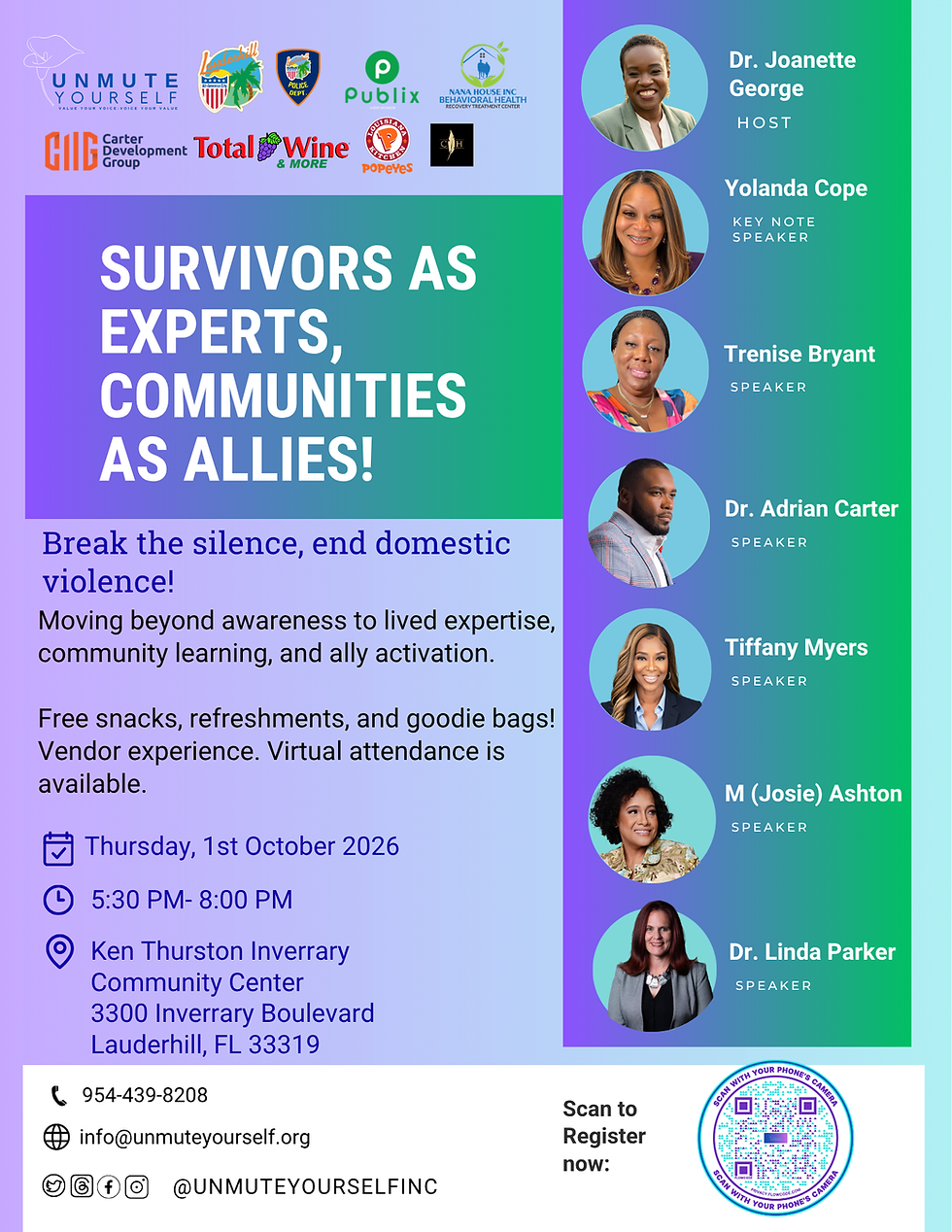
On Thursday, October 1, 2026, Unmute Yourself, Inc. will convene its 4th Annual “Break the Silence, End Domestic Violence” Symposium in Lauderhill. This year's theme, “Survivors as Experts, Communities as Allies,” represents more than an annual slogan. It reflects an intentional evolution in how I believe we must approach interpersonal violence. We have spent considerable time creating awareness about domestic violence. Now we must ask whether our awareness has produced better listeners, earlier interventions, stronger systems, more informed communities, and safer pathways for people experiencing abuse.
That question feels especially urgent when we consider what continues to appear in our communities and across our news feeds. The headlines are painfully familiar: a domestic-related shooting, a woman killed by a current or former intimate partner, children caught within family violence, or a murder-suicide that leaves an entire community trying to understand what happened. These incidents often receive intense attention for several days. Photographs are shared. Neighbors are interviewed. Vigils are held.
Then the news cycle moves forward. The consequences do not.
Beyond the Headline
The data remind us that domestic violence is not a marginal social problem. According to the Florida Department of Children and Families' 2025 Domestic Violence Annual Report, 103,915 domestic violence offenses were reported to law enforcement in Florida. Law enforcement made 63,464 arrests for domestic violence-related crimes, and 220 people died because of domestic violence homicide. Those deaths represented approximately 20 percent of all homicides in Florida.
Numbers of this magnitude should disrupt the tendency to conceptualize domestic violence as a private matter occurring between two individuals. Domestic violence may originate within an intimate or familial relationship, but its consequences are unquestionably communal. It enters emergency departments and behavioral health systems. It appears in classrooms through children attempting to learn while living with violence at home. It follows employees into workplaces. It requires police intervention, court involvement, shelter capacity, social services, housing assistance, and community-based advocacy. It enters congregations, sometimes through people who have never disclosed what is happening behind closed doors.
The lethality associated with intimate partner violence deserves particular attention. A Centers for Disease Control and Prevention analysis of National Violent Death Reporting System data identified 3,991 adult female victims of intimate partner homicide between 2018 and 2021 across the jurisdictions included in the study. Among those cases, 68 percent of victims were injured at their residence and 66.6 percent of the homicides involved a firearm. Nearly 29 percent were single-victim homicides followed by the suspected perpetrator's suicide. The researchers also found that 14.7 percent of suspects had known contact with law enforcement during the preceding 12 months, a finding the CDC identified as a potential opportunity for prevention. Importantly, Florida was not included in that particular NVDRS dataset, so those national findings should not be interpreted as Florida-specific estimates.
That last point matters to me as both a scholar and practitioner. Statistics should illuminate a problem, not be manipulated to dramatize one. We do not need to exaggerate domestic violence to establish its seriousness. The documented reality is serious enough.
Recent events have made that reality particularly visible here in South Florida. In June, the Miami-Dade Sheriff's Office investigated the deaths of a mother, father, and their two daughters in Doral. Investigators subsequently reported that the father killed the children's mother and their 11-year-old and 8-year-old daughters before taking his own life. Cases such as this are horrifying, but they also force a larger community question.
What do we do with these stories after the headline disappears? I do not believe our responsibility ends with being saddened by them.
Survivors Have Been Telling Us More Than Their Stories
For decades, survivors have been invited into public conversations about domestic violence primarily to provide testimony. We ask what happened, how the relationship began, when the abuse started, why they stayed, how they escaped, and how they rebuilt their lives. Their experiences humanize statistics and can profoundly affect an audience. But there is a limitation in this model that deserves examination. After the survivor tells the story, we often thank them for their courage and then turn to someone else to provide the expertise.
As an academic, I value scholarship, empirical evidence, professional preparation, and disciplinary knowledge. As a practitioner, I understand the value of clinical, legal, law enforcement, behavioral health, educational, and community-based expertise. As a survivor, however, I also understand that lived experience produces another form of knowledge. Someone who has navigated coercive control, fear, manipulation, institutional systems, leaving, returning, safety planning, rebuilding, and recovery may understand dimensions of domestic violence that cannot be completely captured by a textbook, professional credential, or dataset.
These forms of knowledge should not compete. They should converse.
That is the intellectual premise behind “Survivors as Experts, Communities as Allies.” At this year's symposium, survivor leaders will not simply be brought forward to describe the worst moments of their lives. They will sit alongside multidisciplinary professionals and contribute to the analysis of the problem itself. We want to examine what professionals misunderstand about survivor behavior, what communities routinely miss, which interventions help, which well-intended responses cause additional harm, and what survivors know now that could help us respond differently to the person who comes next.
For years, we have asked survivors, “What happened to you?”
Perhaps the next evolution of this work requires another question:
“What did surviving teach you that the rest of us need to know?”
That shift is significant because lived experience without meaningful influence can become extraction. If we are willing to study survivors, survey survivors, interview survivors, invite survivors onto stages, and use survivor narratives to educate communities, then survivors should also have opportunities to influence the systems, policies, programs, and practices developed in response to domestic violence.
Our Keynote Embodies That Evolution
Our 2026 keynote speaker, Yolanda Cope, embodies precisely why this distinction matters. Yolanda is a domestic violence survivor, author, public servant, community advocate, and active volunteer whose work extends throughout Palm Beach County. Her expertise is not confined to the experience of having survived violence. It also includes what she has chosen to build from that experience through service, advocacy, leadership, and community engagement. That is important!
Too often, survivors become permanently associated with what was done to them. Their identity remains attached to the violence even after their lives have expanded far beyond it. Yet survivors become executives, educators, public servants, clinicians, parents, advocates, entrepreneurs, researchers, clergy, community leaders, and policymakers. Survival may inform their expertise without defining the totality of who they are. On October 1, we will give that expertise the microphone.
Communities as Allies Requires More Than Sympathy
The second half of our theme carries an equally important responsibility. Communities as Allies means that domestic violence prevention and response cannot remain the exclusive responsibility of domestic violence organizations.
Most people experiencing abuse will spend considerably more time around coworkers, relatives, neighbors, healthcare professionals, educators, faith leaders, friends, and other community members than they will with a domestic violence specialist. The first disclosure may therefore happen in an ordinary setting. It may happen in a classroom, an office, a salon, a church, a doctor's office, or a conversation between friends.
And the person disclosing may never say, “I am experiencing domestic violence.”
They may say, “He doesn't like me going anywhere without him.”
They may say, “She checks my phone.”
They may say, “I can't stay long because I need to get home.”
They may repeatedly cancel plans. Their work performance may change. They may become increasingly isolated. Someone may notice injuries, fear, financial control, stalking, threats, or a dramatic change in behavior without understanding what those observations could mean.
The question then becomes whether the person receiving those signals knows enough to respond without judgment, coercion, or dangerous advice.
Being an ally does not mean becoming a domestic violence professional. It means becoming informed enough to recognize that something may be wrong, respond in ways that preserve dignity and autonomy, connect people with appropriate resources, and understand when professional or emergency intervention is necessary. It also means relinquishing one of the most persistent and damaging questions in conversations about domestic violence: “Why didn't you just leave?”
Leaving can be a process rather than an event. Risk can change during separation. Financial dependency, children, housing, immigration concerns, fear, threats, emotional attachment, coercive control, isolation, and previous experiences with institutions can all affect decision-making. Understanding those complexities does not remove survivor agency. It allows communities to respond to that agency more intelligently.
That is why I want educators in this room. I want behavioral health professionals in this room. I want clergy, healthcare workers, employers, law enforcement officers, elected officials, social workers, students, parents, advocates, and ordinary community members in this room. Domestic violence is multidisciplinary whether our response to it is or not.
This Year, Silence Will Sound Different
One of the most meaningful moments of this year's symposium will also be one of the most difficult.
A young woman who volunteered at our very first Domestic Violence Symposium recently lost her life to intimate partner violence. She was only 20 years old.
There is a particular weight to that loss for our organization. She once stood in the very movement created to confront the violence that would later touch her own life. I have wrestled with how we acknowledge that reality without exploiting her death, centering the circumstances of her passing, or turning remembrance into spectacle.
Traditionally, we honor those we have lost with a moment of silence. This year, we will offer a Moment of Sound.
Participation will be voluntary and intentionally trauma-informed. Attendees who choose to participate will be invited to release a sound, speak a word, clap, cry, hum, or otherwise express what grief, frustration, anger, love, and resolve sound like to them. Others may choose to remain quietly present and witness the moment.
The purpose is not performance. It is recognition. Violence has taken enough silence!
We will honor her life without reducing her life to how it ended. Then we will allow that remembrance to ask something of us. If we are devastated when a young life is lost, what are we willing to learn and do while other young lives can still be reached?
From Awareness to Allyship
There will also be celebration in the room because effective prevention work cannot consist only of naming what is broken. We must also recognize what people are building.
This year, we will celebrate the graduation of our Domestic Violence Allies, individuals who have made the intentional decision to deepen their understanding and increase their capacity to respond. For me, that graduation represents what the symposium is ultimately designed to produce. I am not interested solely in counting how many people attended an event. I am interested in what those people become capable of doing afterward.
Education that remains in the room has limited utility. The value of knowledge is demonstrated in its application.
If an educator recognizes a warning sign earlier, that matters. If a clergy member responds differently when someone discloses abuse, that matters. If an employer understands that what appears to be an attendance or performance issue may have another explanation, that matters. If a friend learns to replace judgment with a question such as, “How can I support you safely?” that matters.
That is the movement from observer to learner, learner to ally, and ally to advocate.
It is also why I continue to say that awareness without action is anesthesia. Awareness can make us feel informed while allowing us to remain unchanged. The goal of this symposium is not simply to make people feel something. It is to help people know something they can use.
There Must Also Be Room for Joy
There is another dimension of survivor-centered work that deserves greater attention. Domestic violence programming can become so focused on trauma that survivors are repeatedly invited to inhabit pain publicly. Yet recovery is not simply the cessation of violence. Restoration includes identity, creativity, pleasure, expression, purpose, beauty, relationships, laughter, and the freedom to imagine a future. So yes, there will be joy in this room too.
Guests will receive a special teaser of our upcoming fashion showcase and a first glimpse of what Unmute Yourself is preparing for our Anniversary Soirée on May 1, 2027. That element may appear, at first glance, unrelated to domestic violence scholarship. I would argue otherwise. A survivor-centered framework must make room not only for how people survive, but also for how they live afterward.
October 1 will offer the preview. May 1, we unveil the experience.
Partnership Matters, and So Does Presence
This symposium will also carry particular significance as the final Unmute Yourself Domestic Violence Symposium with Lauderhill Police Chief Stanley in her current role. Her presence over the years represents an important principle underlying our work: no single institution can solve interpersonal violence.
Community organizations cannot do it alone. Law enforcement cannot do it alone. Behavioral health professionals cannot do it alone. Government cannot do it alone. Faith communities cannot do it alone. Survivors should certainly not be expected to solve the systems that failed to protect them.
Effective community response requires collaboration across disciplines and, critically, requires survivor expertise within those collaborations.
That is why this year's symposium is intentionally structured as a room where different forms of knowledge meet. Professional expertise belongs there. Institutional authority belongs there. Community knowledge belongs there.
Academic research belongs there. And lived expertise belongs there.
I Want You in the Room
Virtual participation will be available because accessibility matters. But if you are able to attend physically, I am asking you to be in the room.
Not because we need another audience. We don't. We need participants in a community conversation that has consequences beyond October 1.
There is something qualitatively different about sitting beside survivors, law enforcement officers, clinicians, advocates, educators, public servants, faith leaders, students, elected officials, and community members and realizing that no person in the room possesses the entire solution. Each brings a different piece.
We already agree that domestic violence is wrong. That is the easiest conclusion we will reach all evening. The harder work begins after that.
What are we missing? What do our systems misunderstand? Which assumptions about survivors continue to shape our responses? What opportunities for intervention are being overlooked? How do we help without controlling? How do we respect survivor autonomy while responding seriously to risk? How do we bring lived expertise into decision-making before another policy, program, or intervention is designed for survivors without survivors?
And perhaps the most important question of the evening:
Because of what I learned tonight, what will I do differently?
That is the question I want every person carrying out of the room.
There are events you can hear about afterward. There are programs you can catch next year. There are conversations for which reading the recap is enough. I do not believe this is one of them.
On October 1, we will learn. We will challenge assumptions. We will honor a young life. We will recognize community allies. We will celebrate partnership. We will make room for survivor expertise, professional expertise, scholarship, community knowledge, grief, joy, and action.
And then we will decide what happens next.
Be in the Room.
4th Annual “Break the Silence, End Domestic Violence” SymposiumSurvivors as Experts, Communities as Allies
Thursday, October 1, 20266:00 PM to 8:00 PM | Doors open at 5:30 PM
Ken Thurston Inverrary Community Center
3300 Inverrary Blvd., Lauderhill, FL 33313
In-person and virtual attendance available.
Registration: www.tinyurl.com/unmuteyourselfevents
Bring your colleague. Bring your pastor. Bring your staff member. Bring your neighbor. Bring the person who works with families every day but has never received meaningful domestic violence education. Bring the person who wants to help but does not yet know how.
Domestic violence is not simply a survivor issue. It is a community responsibility. We have spent enough time asking survivors to prove that domestic violence exists. We know it exists.
Now we must become better at recognizing it, responding to it, interrupting it, and learning from the people who understand it in ways many of us never will.
Survivors as Experts. Communities as Allies. Because awareness is where this work begins. Action is where it becomes consequential.
References
Florida Department of Children and Families. (2025). Domestic Violence Annual Report 2025. The report documents 103,915 domestic violence offenses reported to Florida law enforcement, 63,464 arrests for domestic violence-related crimes, and 220 domestic violence homicide deaths, representing approximately 20 percent of Florida homicides.
Rowh, A., & Jack, S. (2024). Notes from the Field: Intimate Partner Homicide Among Women, United States, 2018–2021. Morbidity and Mortality Weekly Report, 73, 754–756. Centers for Disease Control and Prevention. https://doi.org/10.15585/mmwr.mm7334a4
Miami-Dade Sheriff's Office. (2026, June 4). Homicide Detectives Investigating Murder-Suicide in Doral: Update.
Dr. Joanette Brookes-George
Founder & Principal Consultant
Unmute Yourself, Inc.
Value Your Voice. Voice Your Value.


Comments